6 Question Types Every Teacher Should Use (with Examples)
What each of the six common question types really tests, examples you can adapt, mistakes to avoid, and how to combine them into a fair paper.
In this article ▾
The questions you choose decide what your test actually measures. A paper made only of MCQs checks recall across a wide range of topics but says little about whether a student can explain an idea. A paper of only long answers tests depth but covers fewer topics and takes ages to check. The best papers mix question types on purpose.
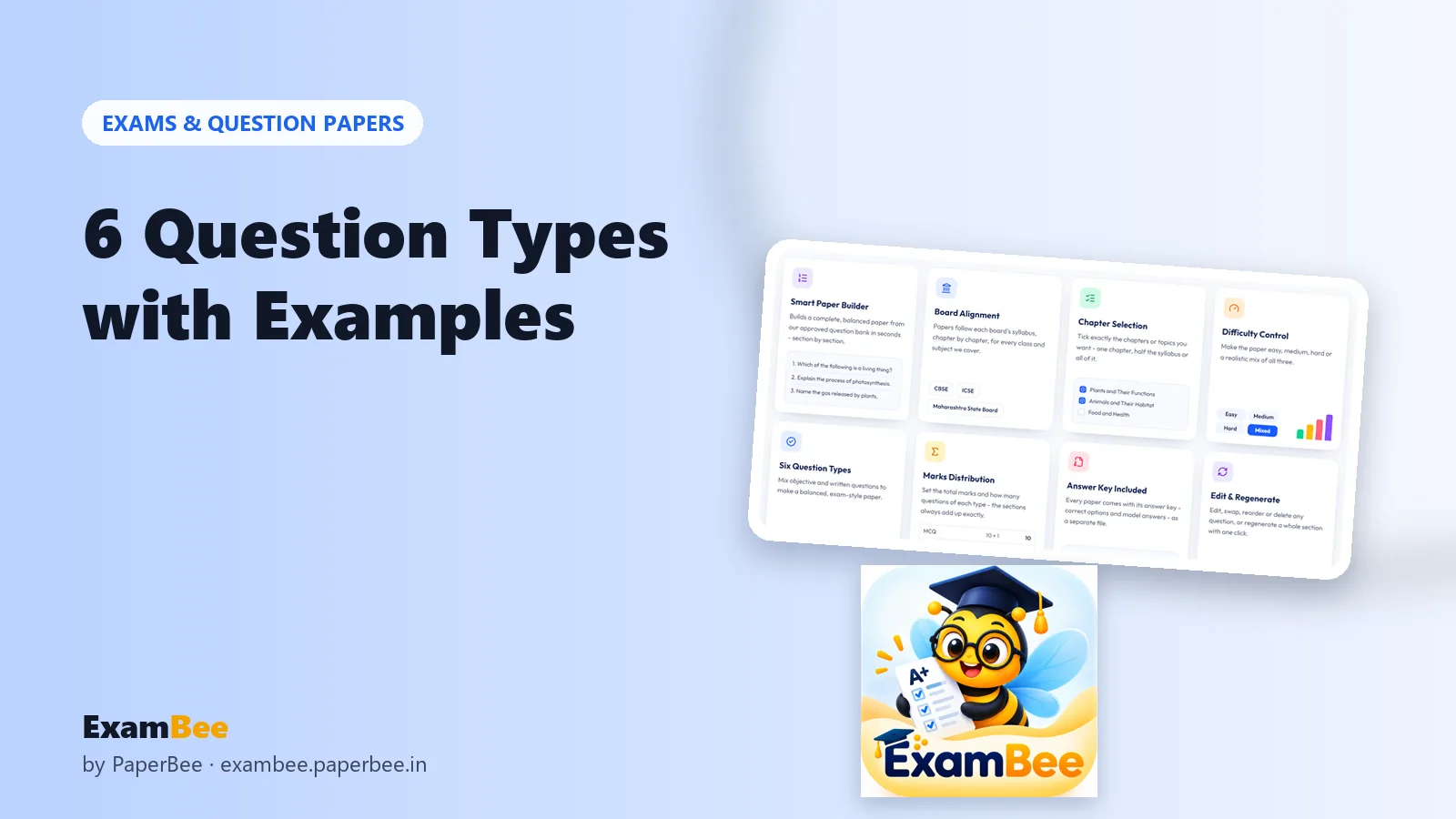
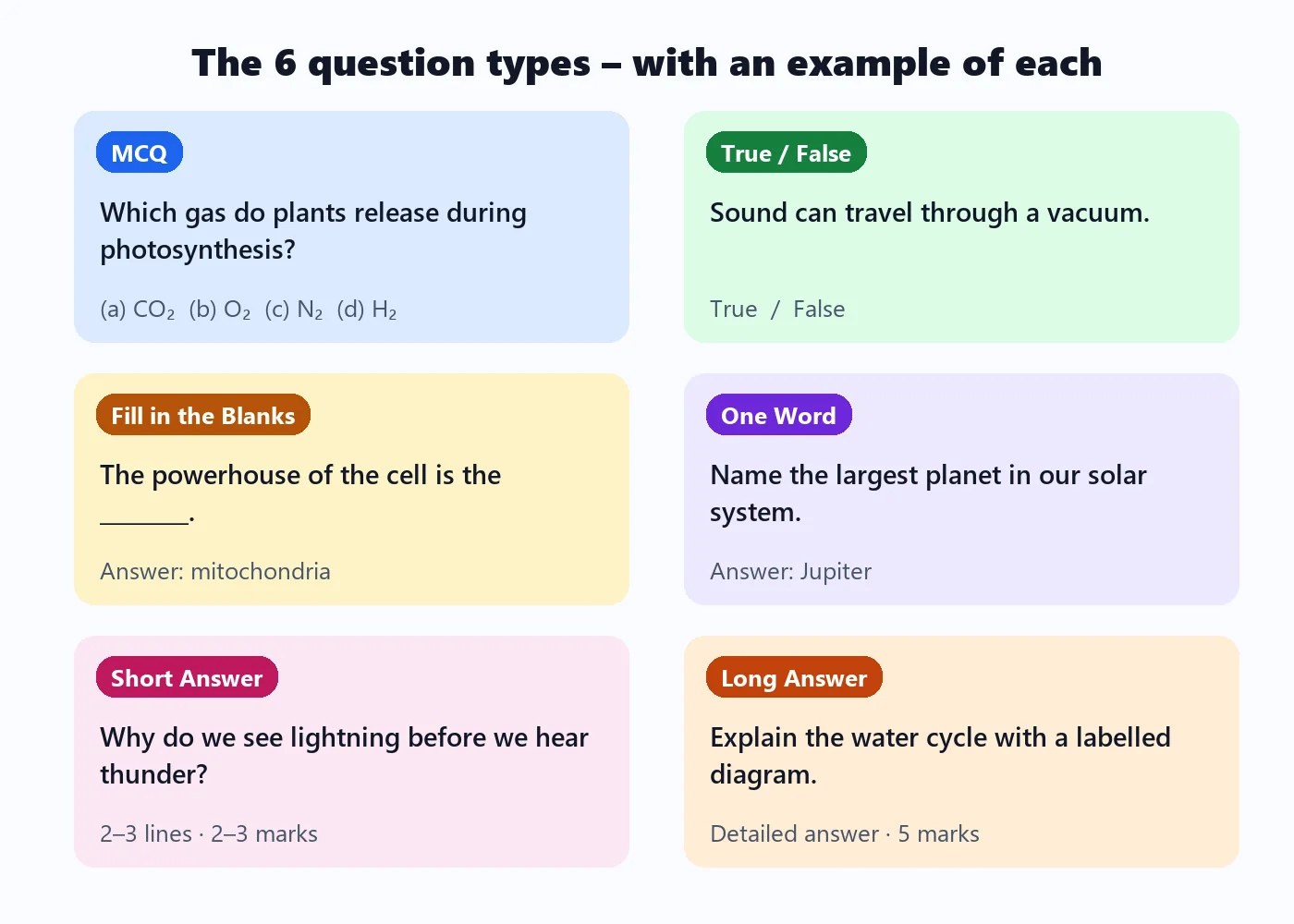
Here are the six types you'll find in most school papers – and in ExamBee – with what each is good for and an example you can adapt.
1. Multiple Choice Questions (MCQ)
Tests: recall, recognition and quick application across many topics.
Example: Which gas do plants release during photosynthesis? (a) Carbon dioxide (b) Oxygen (c) Nitrogen (d) Hydrogen
- Make every wrong option plausible – ideally a common misconception.
- Keep options similar in length so the longest isn't always correct.
- Avoid “all of the above” and “none of the above”.
2. True / False
Tests: whether students can spot a correct or incorrect statement – useful for common misconceptions.
Example: Sound can travel through a vacuum. (True / False)
- Keep statements short and clearly true or false.
- Avoid trick words like “always” and “never” unless that's the point.
- Use a few, not many – guessing gives a 50% chance.
3. Fill in the Blanks
Tests: recall of key terms, definitions and facts.
Example: The powerhouse of the cell is the ________.
- Leave only one blank per sentence.
- Blank out a key term, not a minor word.
- Make sure only one answer fits.
4. One Word Answer
Tests: precise recall – names, terms, formulas, dates.
Example: Name the largest planet in our solar system. (Answer: Jupiter)
- Ask for one clear term.
- Great for quick revision and warm-up sections.
5. Short Answer
Tests: understanding and explanation in a few sentences – the bridge between recall and reasoning.
Example: Why do we see lightning before we hear thunder? (2–3 marks)
- Use command words: explain, give a reason, differentiate.
- Match the marks to the number of points expected.
- Write the key points in your marking scheme before the exam.
6. Long Answer
Tests: depth – organising ideas, describing processes, solving multi-step problems, drawing labelled diagrams.
Example: Explain the water cycle with a labelled diagram. (5 marks)
- Break the marks down in the answer key (for example: diagram 2, explanation 3).
- Offer an internal choice in board-style papers.
- Keep the number of long answers realistic for the time allowed.
Objective vs written questions at a glance
| Type | Tests | Time to answer | Time to check |
|---|---|---|---|
| MCQ | Recall, recognition | ≈1 min | Very fast |
| True / False | Spotting errors | <1 min | Very fast |
| Fill in the Blanks | Key terms | ≈1 min | Fast |
| One Word | Precise recall | <1 min | Fast |
| Short Answer | Understanding | 3–5 min | Moderate |
| Long Answer | Depth, reasoning | 8–10 min | Slow |
How to mix them in one paper
For younger classes (5–7)
Lean on MCQ, True/False, Fill in the Blanks and One Word, with a few short answers. Students get many chances to show what they know.
For middle classes (8–10)
Use all six types. Objective questions cover the breadth of the syllabus; short and long answers check understanding and prepare students for board exams.
For senior classes (11–12)
Increase short and long answers that test application and reasoning, while keeping some objective questions for coverage.
For a full worked example with marks and timing, read how to set a balanced question paper.
Match question types to thinking skills
A useful way to plan a paper is to ask what kind of thinking each question needs. Educators often describe this as moving from remembering to understanding to applying and analysing:
| Thinking skill | Good question types | Example command words |
|---|---|---|
| Remember | MCQ, One Word, Fill in the Blanks | Name, list, define, state |
| Understand | True/False, MCQ, Short Answer | Explain, describe, give a reason |
| Apply | Short Answer, Long Answer | Calculate, solve, use, show |
| Analyse | Long Answer | Compare, differentiate, examine |
A paper that only asks students to remember will feel easy and tell you little. Include a few questions at each level so every student is challenged appropriately.
Common mistakes to avoid
- Too many objective questions in a senior-class paper, leaving no room to test reasoning.
- Ambiguous wording that has more than one correct answer.
- Giveaway clues – an option that is grammatically the only fit, or a True/False statement with “always”.
- Marks that don't match effort – a 1-mark question that needs a paragraph, or a 5-mark question answered in a line.
- No answer key – checking becomes slow and inconsistent between teachers.
Choosing question types in ExamBee
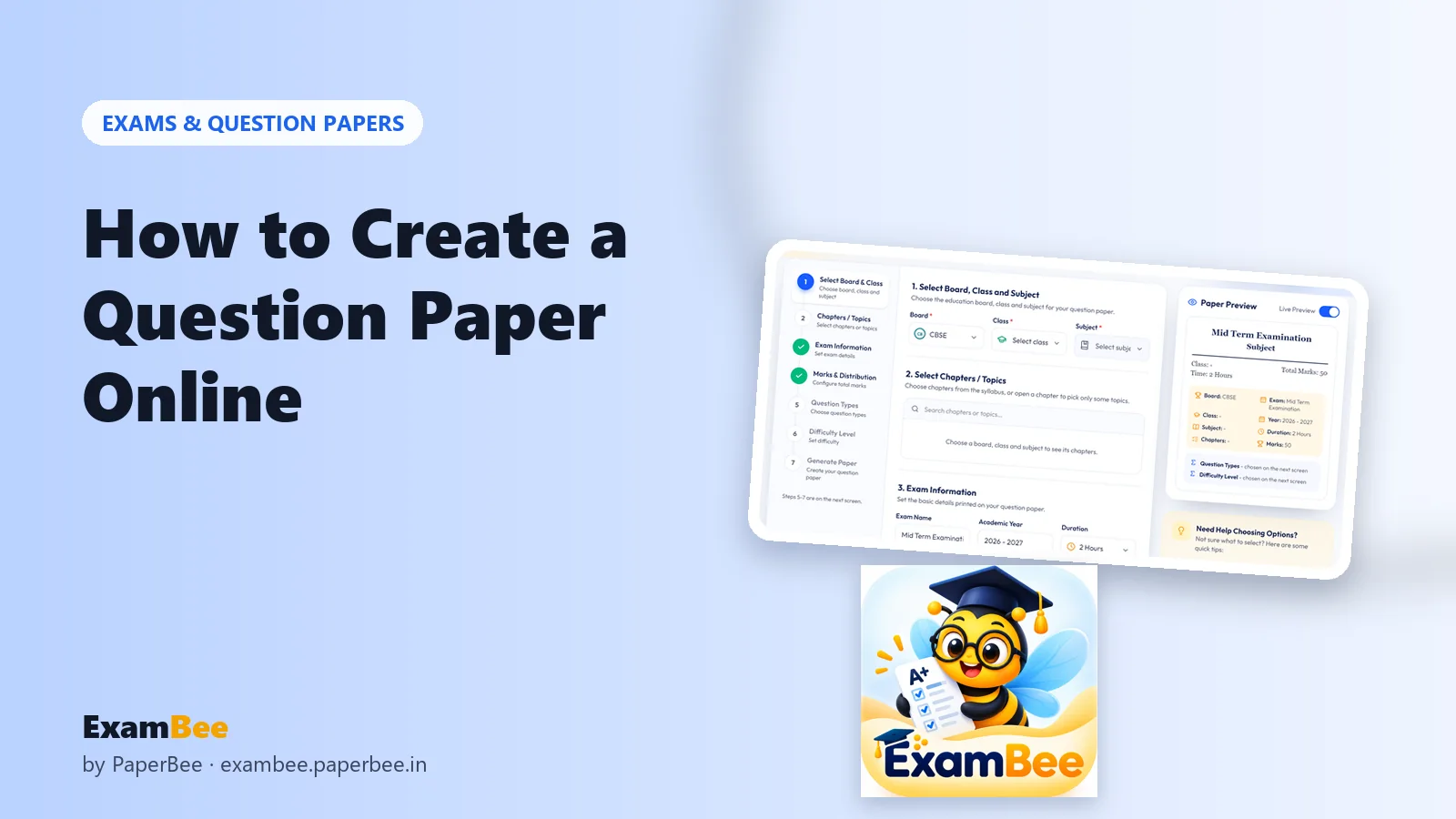
In ExamBee's question paper generator you set the total marks and how many questions of each of the six types you want; ExamBee picks approved questions from the chapters you selected and makes the sections add up exactly. You can then swap or edit any question before downloading the paper and its answer key.
Summary
MCQ, True/False, Fill in the Blanks and One Word questions cover breadth quickly; Short and Long Answers check understanding and depth. Mix them according to the class and the purpose of the test, write each type carefully, and prepare the answer key in advance. To put it into practice, start with how to create a question paper online or your board's guide – CBSE, ICSE or Maharashtra State Board.
Frequently asked questions
What are the main types of questions in an exam?
MCQ, True/False, Fill in the Blanks, One Word, Short Answer and Long Answer.
What is the difference between objective and subjective questions?
Objective questions (MCQ, True/False, Fill in the Blanks, One Word) have one correct answer and are quick to check; subjective or written questions (Short and Long Answer) need explanation and are marked against key points.
How many MCQs should a paper have?
It depends on the class and marks, but objective questions often make up roughly a third of a school paper, with the rest written answers.
Can ExamBee include all six question types?
Yes. You choose how many questions of each type to include, and ExamBee builds the paper from approved questions.
How do I write good MCQ options?
Make wrong options plausible (common mistakes), keep options similar in length, and spread correct answers across A to D.
Written by the PaperBee Team
We build free tools that help schools, shops and organisers create professional documents — from QR codes to ID cards and certificates.