How to Set a Balanced Question Paper: Marks, Difficulty and Question Types
A good paper isn't just a list of questions. Here's how to plan marks, difficulty and question types so your test is fair, finishes on time and actually measures learning.
In this article ▾
Every teacher has seen it: a test where the whole class scores 90%, or one where half the students run out of time before the last section. Both are signs of an unbalanced question paper. A balanced paper covers the syllabus fairly, mixes easy and challenging questions, uses a variety of question types and can be finished comfortably in the time allowed.
This guide walks through the planning that experienced paper-setters do – and shows how a generator like ExamBee handles most of it for you.
Start with a blueprint
A blueprint is a one-page plan of the paper before you write a single question: which chapters, how many marks each, which question types and what difficulty. It keeps the paper fair and makes the actual writing much faster.
1. Weight chapters by teaching time
A chapter you spent three weeks on deserves more marks than one you covered in two days. A simple rule: share the total marks in proportion to the periods spent on each chapter, then round to whole questions.
2. Decide the sections
Group questions by type into sections – objective first, written last – so students warm up with quick wins and finish with the questions that need the most thought.
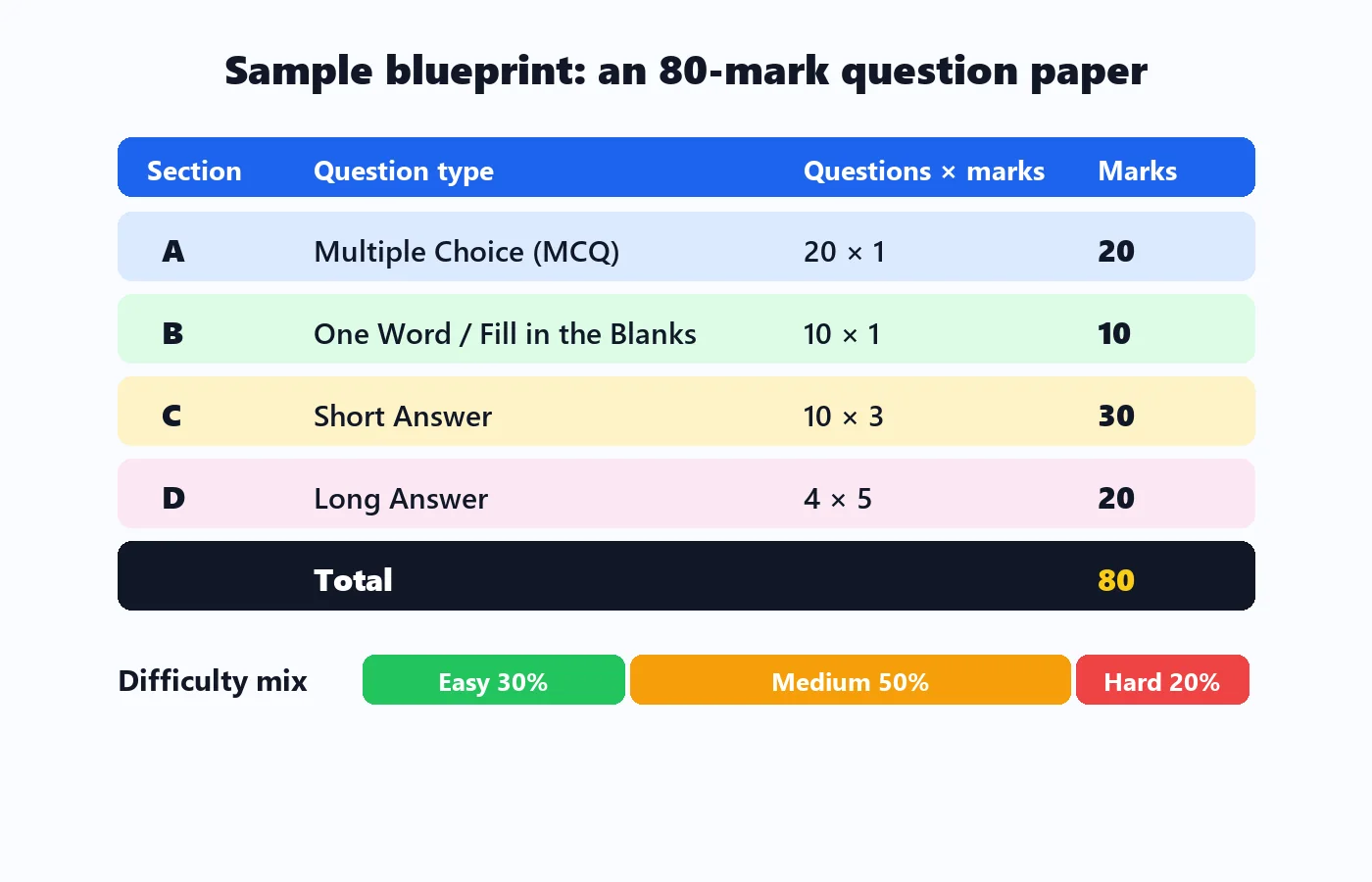
| Section | Question type | Questions × marks | Marks |
|---|---|---|---|
| A | Multiple Choice (MCQ) | 20 × 1 | 20 |
| B | One Word / Fill in the Blanks | 10 × 1 | 10 |
| C | Short Answer | 10 × 3 | 30 |
| D | Long Answer | 4 × 5 | 20 |
| Total | 80 |
Get the difficulty mix right
A widely used starting point is roughly 30% easy, 50% medium and 20% hard. Easy questions let every student show what they know; medium questions separate understanding from memorisation; a few hard questions stretch your strongest students.
- Chapter or unit tests: lean easier – the goal is feedback, not ranking.
- Term exams: use a realistic mix.
- Board practice / pre-boards: shift towards medium and hard.
In ExamBee you simply choose Easy, Medium, Hard or Mixed for the paper.
Mix the question types
Objective questions (MCQ, True/False, Fill in the Blanks, One Word) test recall and quick understanding across many topics. Written questions (Short and Long Answer) test explanation, application and reasoning. A good paper uses both. See 6 question types with examples for when to use each.
Plan the time
| Question type | Time per question |
|---|---|
| MCQ / True-False / One Word / Fill in the Blanks | About 1 minute |
| Short Answer (2–3 marks) | 3–5 minutes |
| Long Answer (5 marks) | 8–10 minutes |
Add up the times for your blueprint and leave 10–15 minutes for reading and revision. For the 80-mark example: 30 objective questions (about 30 min) + 10 short answers (about 40 min) + 4 long answers (about 40 min) ≈ 110 minutes – comfortable in a 3-hour paper and tight but possible in 2 hours. Adjust if needed.
Write clear questions
- Use simple, unambiguous language – test the subject, not reading skill.
- Make every MCQ option believable; wrong options should be common mistakes.
- Spread correct MCQ answers across A, B, C and D.
- Avoid “all of the above” and double negatives.
- State the marks next to every question so students can plan their time.
Prepare the answer key and marking scheme
Write the answer key while the paper is fresh: correct options for objective questions and the key points expected in written answers, with marks for each point. It makes checking faster and fairer, especially when several teachers mark the same paper. ExamBee produces an answer key automatically for every paper, as a separate PDF.
Let a generator do the heavy lifting
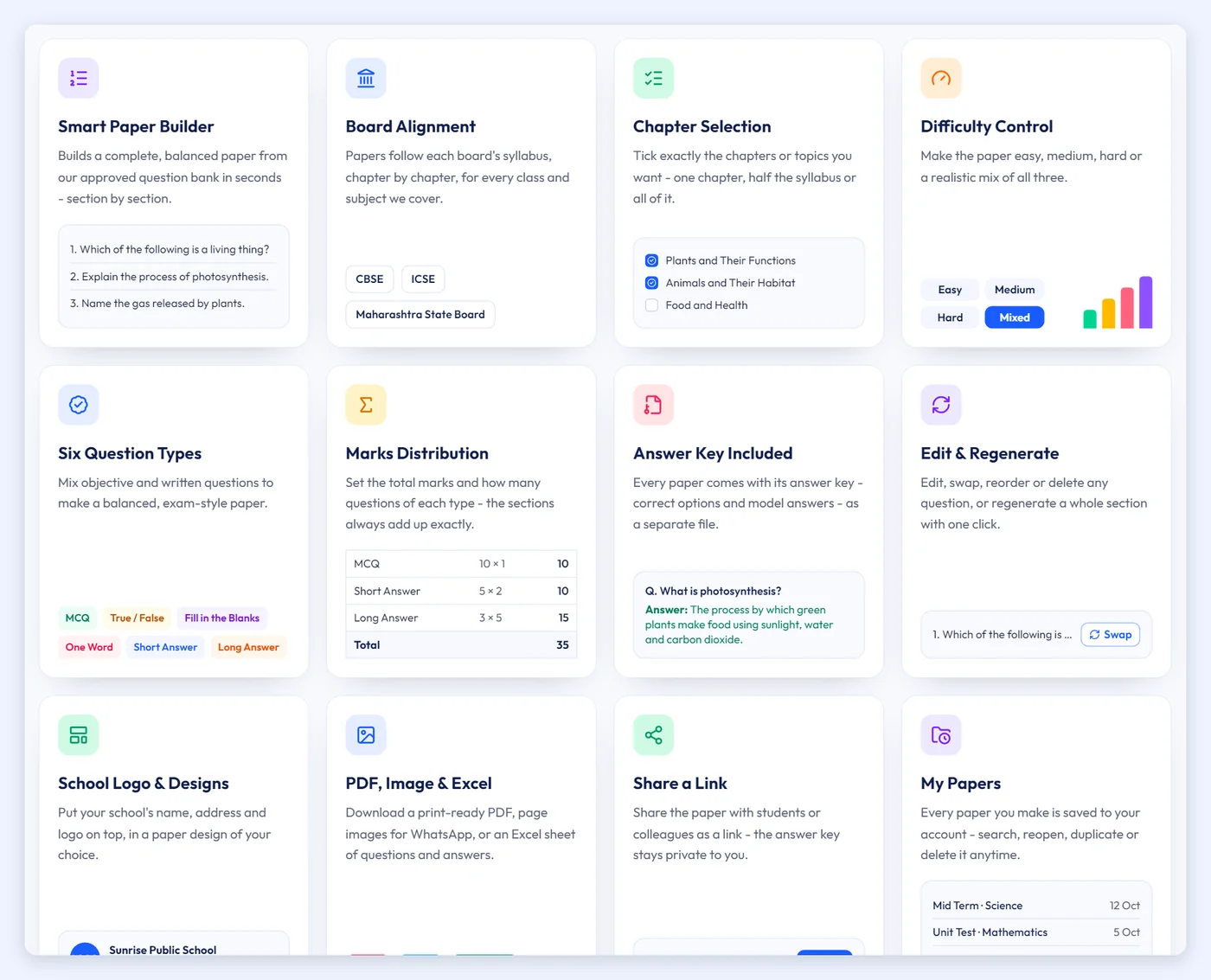
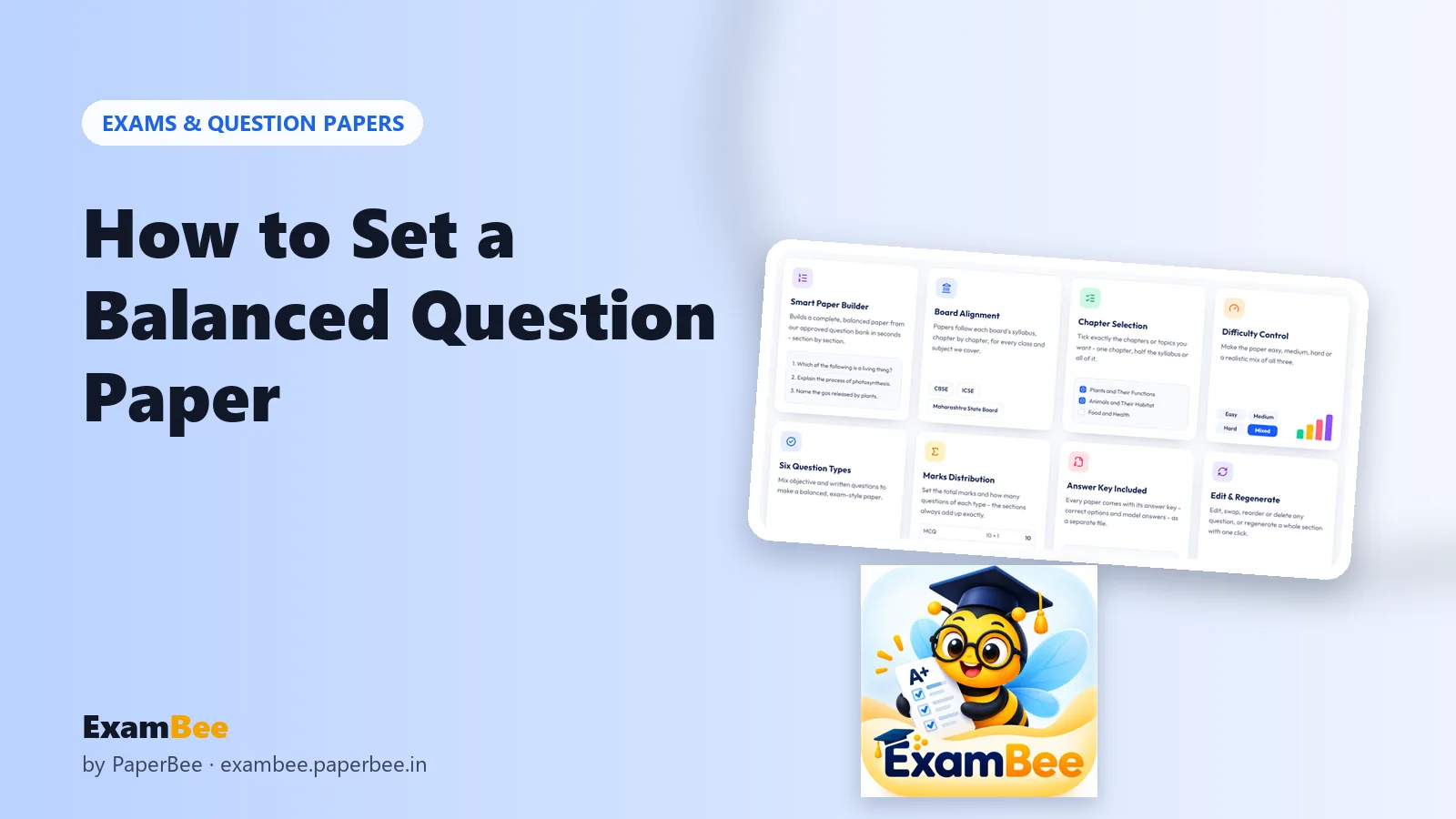
With ExamBee's question paper generator you set the blueprint and it does the rest:
- Tick the chapters (or topics) you've taught.
- Set the total marks and how many questions of each type – sections always add up exactly.
- Choose the difficulty.
- Get a formatted paper with your school's logo and an answer key, then edit or swap any question.
Final checklist before you print
- Every chapter taught is represented, and nothing untaught is included.
- Marks per section add up to the total.
- Difficulty mix suits the purpose of the test.
- The paper can be finished in the time allowed.
- Instructions, marks and question numbers are clear.
- The answer key is ready – and kept separately.
Summary
A balanced question paper starts with a blueprint: weight chapters by teaching time, organise sections by question type, aim for a sensible difficulty mix, plan the time and write clear questions with an answer key. ExamBee turns that blueprint into a ready-to-print paper for CBSE, ICSE and Maharashtra State Board classes 5 to 12.
Frequently asked questions
What is a question paper blueprint?
A one-page plan of a paper listing chapters, marks per chapter, question types and difficulty before the questions are written.
What is a good difficulty mix?
A common starting point is about 30% easy, 50% medium and 20% hard questions, adjusted for the purpose of the test.
How long should a student spend on each MCQ?
About a minute. Short answers take 3–5 minutes and 5-mark long answers about 8–10 minutes.
Can ExamBee make the marks add up automatically?
Yes. You set the total and the number of questions of each type, and the sections always add up exactly.
Does ExamBee create the answer key?
Yes, every paper comes with an answer key as a separate PDF.
Written by the PaperBee Team
We build free tools that help schools, shops and organisers create professional documents — from QR codes to ID cards and certificates.