Invoice Number Format: How to Number Your Invoices (with Examples)
Invoice number meaning, GST numbering rules and ready-to-copy formats like INV/2026-27/0042 – plus how to handle branches, proforma invoices and a new financial year.
In this article ▾
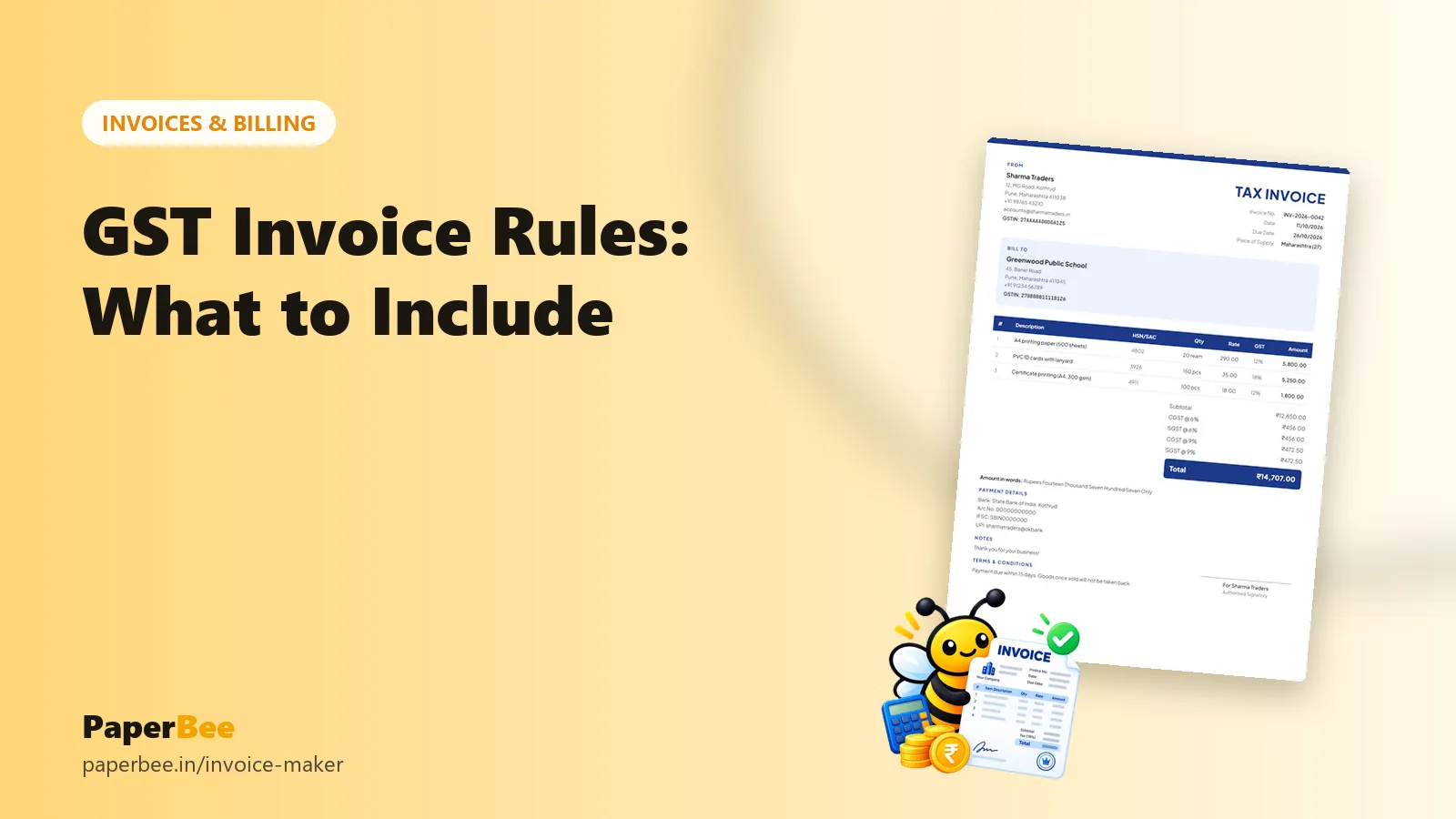
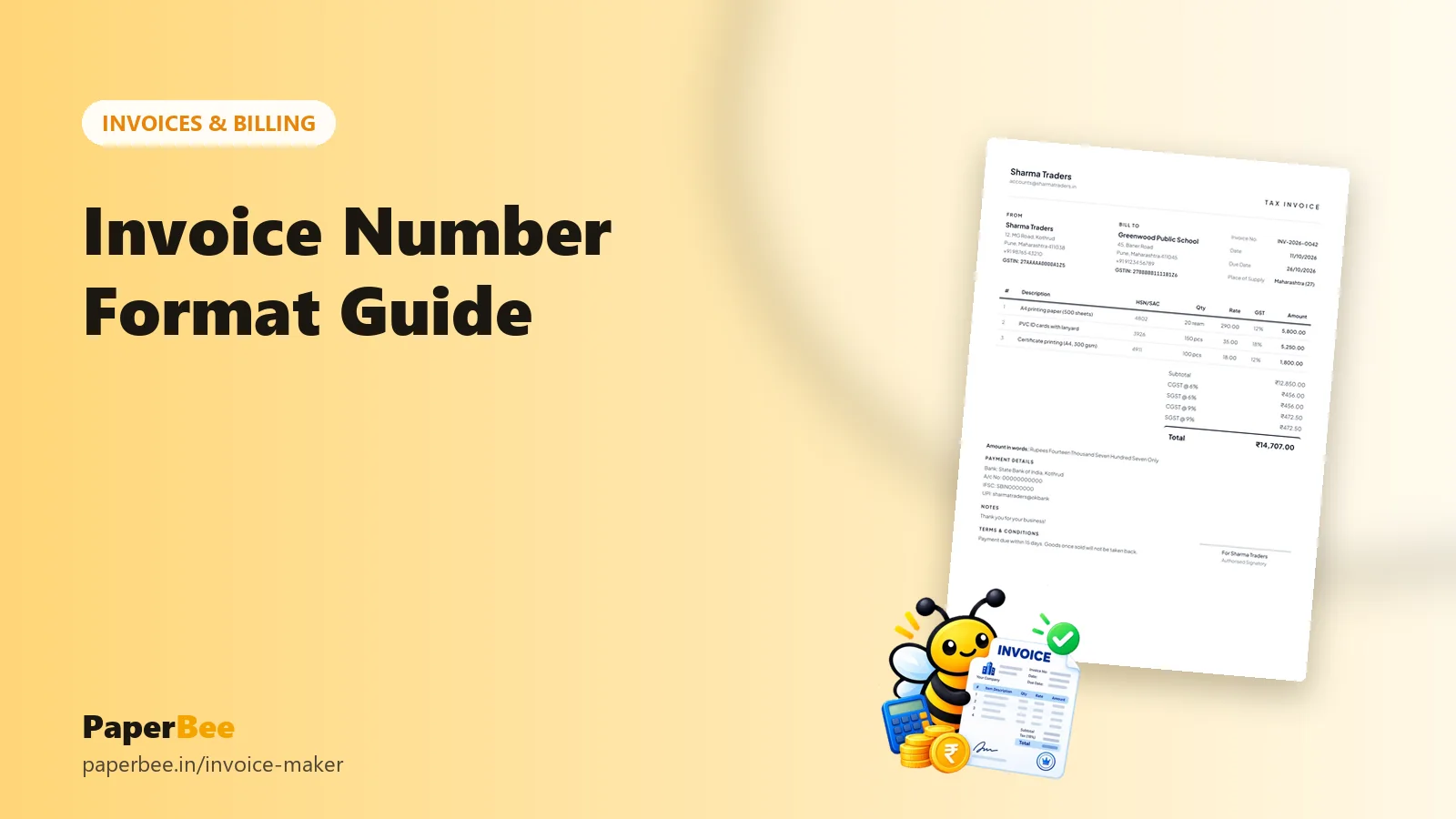
The invoice number is the smallest field on an invoice – and one of the most important. It's how you, your customer and your accountant find a bill, match a payment, and prove that no sales are missing. Here's how to choose a good invoice number format and stick to it.
Invoice number meaning
An invoice number is a unique reference given to each invoice, usually in a running sequence. No two invoices from the same business (in the same series and year) should share a number. In Hindi, it's called बीजक संख्या or simply बिल नंबर.
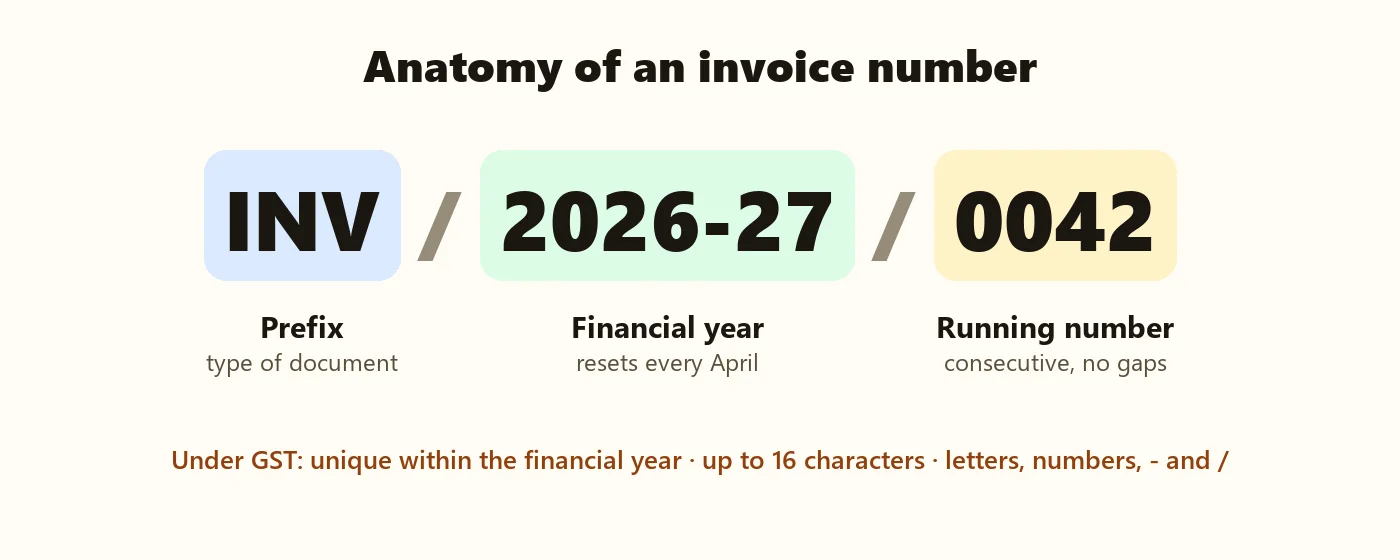
GST rules for invoice numbers
- Consecutive – numbers follow in sequence without gaps.
- Unique for the financial year – most businesses restart the series every 1 April.
- Up to 16 characters.
- Only letters, numbers, hyphens (-) and slashes (/).
- Separate series are allowed (for example per branch or document type), as long as each number is unique.
8 invoice number format examples
| Format | Example | Good for |
|---|---|---|
| Prefix + running number | INV-0042 | Small businesses and freelancers |
| Prefix + financial year + number | INV/2026-27/0042 | GST-registered businesses (resets each April) |
| Year + month + number | 2610-0042 | High-volume shops |
| Branch code + number | PUN/26-27/042 | Multi-branch businesses |
| Customer code + number | GPS-0007 | Agencies with few large clients |
| Proforma series | PI/2026-27/015 | Proforma invoices and quotes |
| Credit note series | CN/2026-27/003 | Credit notes |
| Bill of supply series | BOS/2026-27/021 | Composition dealers and exempt supplies |
How to choose your format
- Pick a short prefix for each document type – INV, PI, CN.
- Add the financial year if you're GST-registered, so the series can restart every April.
- Use leading zeros (0001) so numbers sort correctly in files and spreadsheets.
- Add a branch code only if you bill from more than one location.
- Write the format down and use it for every invoice.
Invoice number vs other reference numbers
An invoice often carries several numbers. Here's how they differ:
| Number | Who creates it | What it identifies |
|---|---|---|
| Invoice number | Seller | This invoice – the bill for the supply |
| Purchase order (PO) number | Buyer | The buyer's order; quote it on the invoice so their accounts team can match it |
| Quotation / proforma number | Seller | The offer made before the sale |
| Receipt number | Seller | A payment received against the invoice |
| Transaction / UTR number | Bank or UPI app | The actual payment transfer |
Starting a new financial year
If your format includes the financial year, simply start again from 0001 on 1 April – INV/2027-28/0001 can't clash with last year's INV/2026-27/0001. If your format has no year, carry on with the next number instead of restarting, so every invoice stays unique.
Switching from handwritten bills
Moving from a bill book to digital invoices? You don't have to start at 1. Continue from the last number in your bill book, or begin a new series with a new prefix from a clear date – and note the switch in your records so your accountant can follow the sequence.
Mistakes to avoid
- Skipping numbers or reusing a cancelled number.
- Using the same series for proforma and tax invoices.
- Random numbers, or dates alone, as invoice numbers – they break the sequence.
- Formats longer than 16 characters on GST invoices.
Cancelled invoices
If you cancel an invoice, keep its number on record marked as cancelled rather than reusing it. This keeps the series complete for audits.
Setting the invoice number in PaperBee
In the invoice maker, type your number in Invoice details. Your last invoice is kept as a draft on your device, so the next one only needs the next number, date, customer and items. Pick any of the 24 invoice formats – the number appears in the header of every design.
Summary
An invoice number is a unique, sequential reference for each invoice. Under GST it must be consecutive, unique for the financial year and up to 16 characters, using letters, numbers, - and /. A format like INV/2026-27/0042 covers all the rules. Learn what else belongs on an invoice in what is an invoice and GST invoice rules.
Frequently asked questions
What is an invoice number?
A unique reference given to each invoice, usually in a running sequence, used to track invoices and match payments.
What should an invoice number look like?
A short prefix, the financial year and a running number with leading zeros – for example INV/2026-27/0042.
Can an invoice number have letters?
Yes. GST invoice numbers can contain letters, numbers, hyphens and slashes, up to 16 characters.
Should invoice numbers restart every year?
Many GST-registered businesses restart the series every financial year, since numbers only need to be unique within the year.
Can I use different series for different branches?
Yes, as long as every invoice number is unique – for example by adding a branch code.
Written by the PaperBee Team
We build free tools that help schools, shops and organisers create professional documents — from QR codes to ID cards and certificates.