GST Invoice Rules: What Every Tax Invoice Must Include (2026 Guide)
Every field a GST tax invoice needs, the rules for numbering, HSN codes and time limits, and the mistakes that cost your customers their input tax credit.
In this article ▾
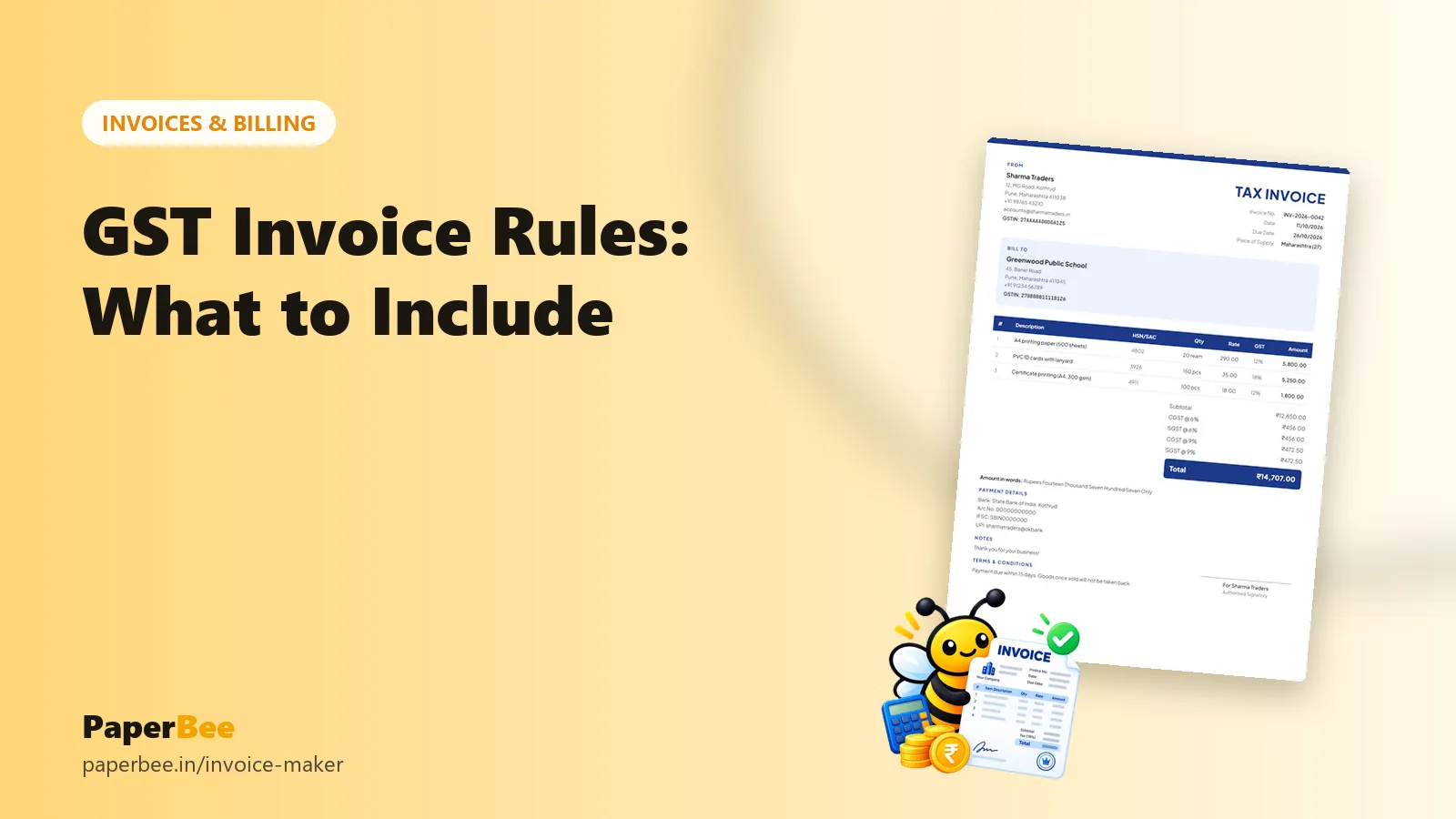
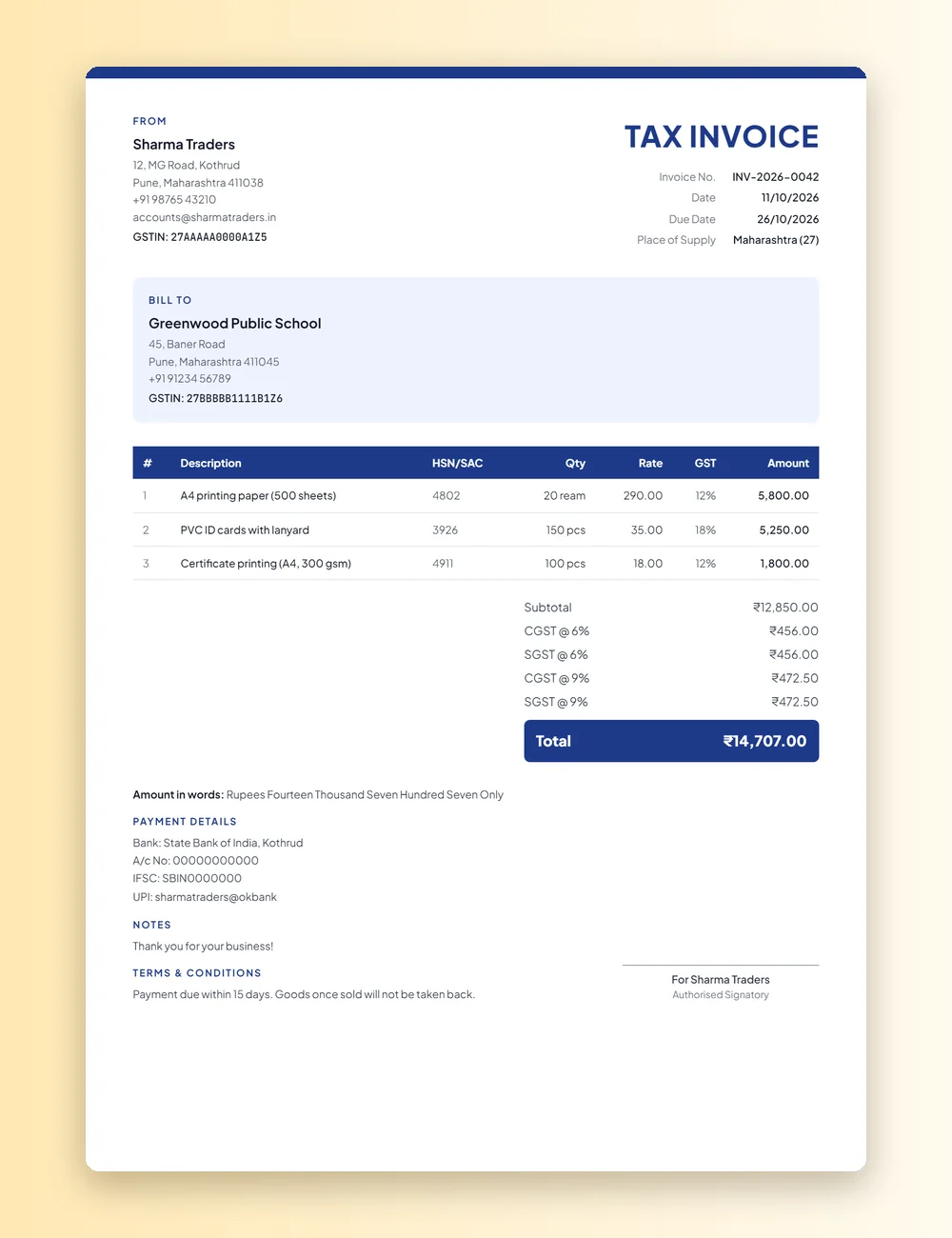
A GST tax invoice isn't just a bill – it's the document your customer needs to claim input tax credit, and the record behind your GST returns. Missing a field can mean a rejected credit, an angry customer and a delayed payment. Here are the rules, in plain language.
Mandatory details on a GST tax invoice
- Name, address and GSTIN of the supplier.
- A consecutive serial number, unique for the financial year, up to 16 characters.
- Date of issue.
- Name, address and GSTIN of the recipient, if registered.
- For an unregistered recipient where the taxable value is above ₹50,000: the recipient's name and address, and the delivery address with the state name and code.
- HSN code for goods or SAC for services.
- Description, quantity and unit of goods or services.
- Total value and taxable value after discount or abatement.
- Rate and amount of tax – CGST, SGST/UTGST, IGST and cess as applicable.
- Place of supply with the state name, for inter-state supplies.
- Delivery address, where it differs from the place of supply.
- Whether tax is payable on reverse charge.
- Signature or digital signature of the supplier or authorised representative.
Invoice number rules
GST invoice numbers must be consecutive, unique within a financial year, and no longer than 16 characters. They can contain letters, numbers, hyphens (-) and slashes (/). A common format is INV/2026-27/0042. You can run separate series for different branches or document types, as long as each is unique. More in our invoice number format guide.
HSN and SAC codes
| Aggregate turnover (previous year) | HSN/SAC digits |
|---|---|
| Up to ₹5 crore | 4 digits (mandatory on B2B invoices) |
| Above ₹5 crore | 6 digits |
CGST + SGST or IGST?
The tax type depends on the place of supply. If it's in the same state as you, charge CGST + SGST (half the rate each). If it's in another state, charge IGST at the full rate. For Union Territories without a legislature, SGST is replaced by UTGST.
| Supply | Tax lines | Total |
|---|---|---|
| Within your state | CGST 9% = ₹900 · SGST 9% = ₹900 | ₹11,800 |
| To another state | IGST 18% = ₹1,800 | ₹11,800 |
When to issue a GST invoice
- Goods: at or before the time of removal (when goods move) or delivery.
- Services: generally within 30 days of supplying the service (a longer period applies to certain sectors such as banking and insurance).
How many copies?
| Supply | Copies |
|---|---|
| Goods | Original for recipient · Duplicate for transporter · Triplicate for supplier |
| Services | Original for recipient · Duplicate for supplier |
Special cases
Small sales to unregistered customers
For very small supplies (generally below ₹200) to unregistered customers who don't ask for an invoice, a registered business may issue a consolidated invoice at the end of the day instead of individual tax invoices.
Bill of supply
Exempt supplies and composition dealers issue a bill of supply instead of a tax invoice – no GST is charged. See the non-GST invoice page.
E-invoicing
Businesses whose turnover exceeds the e-invoicing limit (currently ₹5 crore) must report B2B invoices to the government Invoice Registration Portal, which returns an IRN and a signed QR code to print on the invoice. PaperBee doesn't generate IRNs; smaller businesses can use a regular GST invoice.
Corrections
Once issued, a tax invoice isn't edited. Errors in value or tax are corrected with a credit note (to reduce) or a debit note (to increase).
Common GST invoice mistakes
- Charging CGST + SGST on an inter-state sale, or IGST on an intra-state one.
- A missing or wrong customer GSTIN on a B2B invoice.
- Skipping or repeating invoice numbers in a financial year.
- Calculating GST before the discount instead of on the taxable value.
- Not showing the place of supply on inter-state invoices.
Summary
A GST tax invoice needs the supplier's and (for B2B) recipient's GSTIN, a unique number of up to 16 characters, HSN/SAC codes, taxable value, tax rates and amounts, place of supply and a signature – issued on time, in the right number of copies. The free GST invoice maker has every field ready; read what is an invoice for the basics or proforma vs tax invoice for pre-sale quotes.
Frequently asked questions
What are the mandatory fields in a GST invoice?
Supplier name, address and GSTIN; a unique invoice number and date; recipient details (and GSTIN if registered); HSN/SAC; description, quantity and value; taxable value; tax rates and amounts; place of supply for inter-state sales; reverse charge status; and a signature.
How long can a GST invoice number be?
Up to 16 characters, using letters, numbers, hyphens or slashes, and unique within the financial year.
When should I charge IGST?
When the place of supply is in a different state from your registered place of business.
Can I edit a GST invoice after issuing it?
No. Correct errors with a credit note or debit note instead.
Is e-invoicing mandatory for everyone?
No – only for businesses above the e-invoicing turnover limit (currently ₹5 crore). Check the current notification.
Written by the PaperBee Team
We build free tools that help schools, shops and organisers create professional documents — from QR codes to ID cards and certificates.